
Relatively mild winter 2025/2026
Large differences in sunshine duration. Below-average snowfall at all altitudes.
The preliminary climate assessment by GeoSphere Austria for the meteorological winter (December, January, February) shows significant differences: it was very mild in the mountainous regions and particularly sunny in the western half of Austria, whereas it was comparatively cloudy and cold in the flat and hilly regions and in the basins of the south.
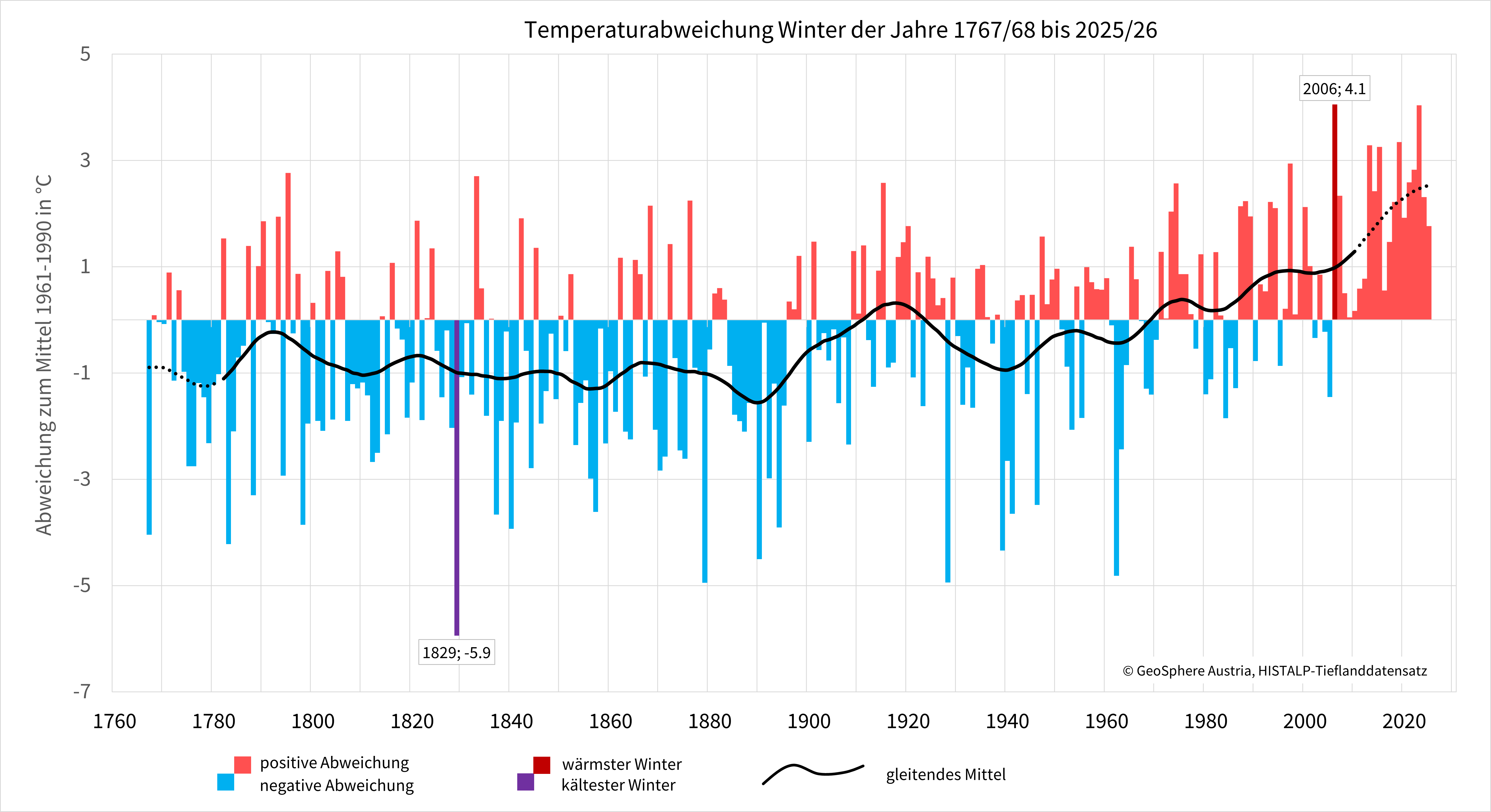
"It was the coldest winter in eight years in the lowlands of Austria. But compared to the entire measurement history, this winter was relatively mild at all altitudes,‘ says climatologist Alexander Orlik from GeoSphere Austria. ’In the preliminary evaluation, the winter of 2025/26 ranks 32nd in the 259-year lowland measurement history and 8th in the 175-year mountain measurement series. "
Compared to the recent past (climate average 1991-2020), the winter of 2025/26 will be 0.5 degrees above average in the lowlands of Austria and 1.9 degrees above average in the mountains. Compared to the period 1961-1990, which was not yet so strongly influenced by global warming, the winter of 2025/26 will be 1.8 degrees above average in the lowlands of Austria and 2.9 degrees above average in the mountains.
Climate_balance_winter_25-26.png
Winter in comparison since 1767: The graph shows above-average warm (red) and cold (blue) winters since 1767 in comparison to the climate reference period 1961-1990, based on GeoSphere Austria HISTALP data for lowlands. The smoothed trend line is shown in black. © GeoSphere Austria.
The winter of 2025/26 was unusually sunny, especially in most of Vorarlberg, Tyrol and Salzburg, as well as in the Salzkammergut region. For example, Bad Aussee had around 30 per cent more hours of sunshine than in an average winter, and Sonnblick had around 25 per cent more.
In the eastern half of Austria, however, the winter was relatively gloomy. The Vienna Hohe Warte weather station, for example, recorded around 30 per cent fewer hours of sunshine than in an average winter. In Klagenfurt, there were 45 per cent fewer hours of sunshine than average, and in Graz 50 per cent fewer.
Across Austria as a whole, the winter of 2025/2026 brought 20 per cent less precipitation than the long-term average. ‘That is significantly too dry, but not as extreme as last year – the winter of 2024/25 brought 44 per cent less precipitation than the long-term average,’ says climatologist Alexander Orlik from GeoSphere Austria.
The regional analysis shows isolated instances of above-average precipitation. For example, the area stretching from the Koralpe mountains across southern Styria to southern Burgenland saw 10 to 30 per cent more precipitation than the long-term average.
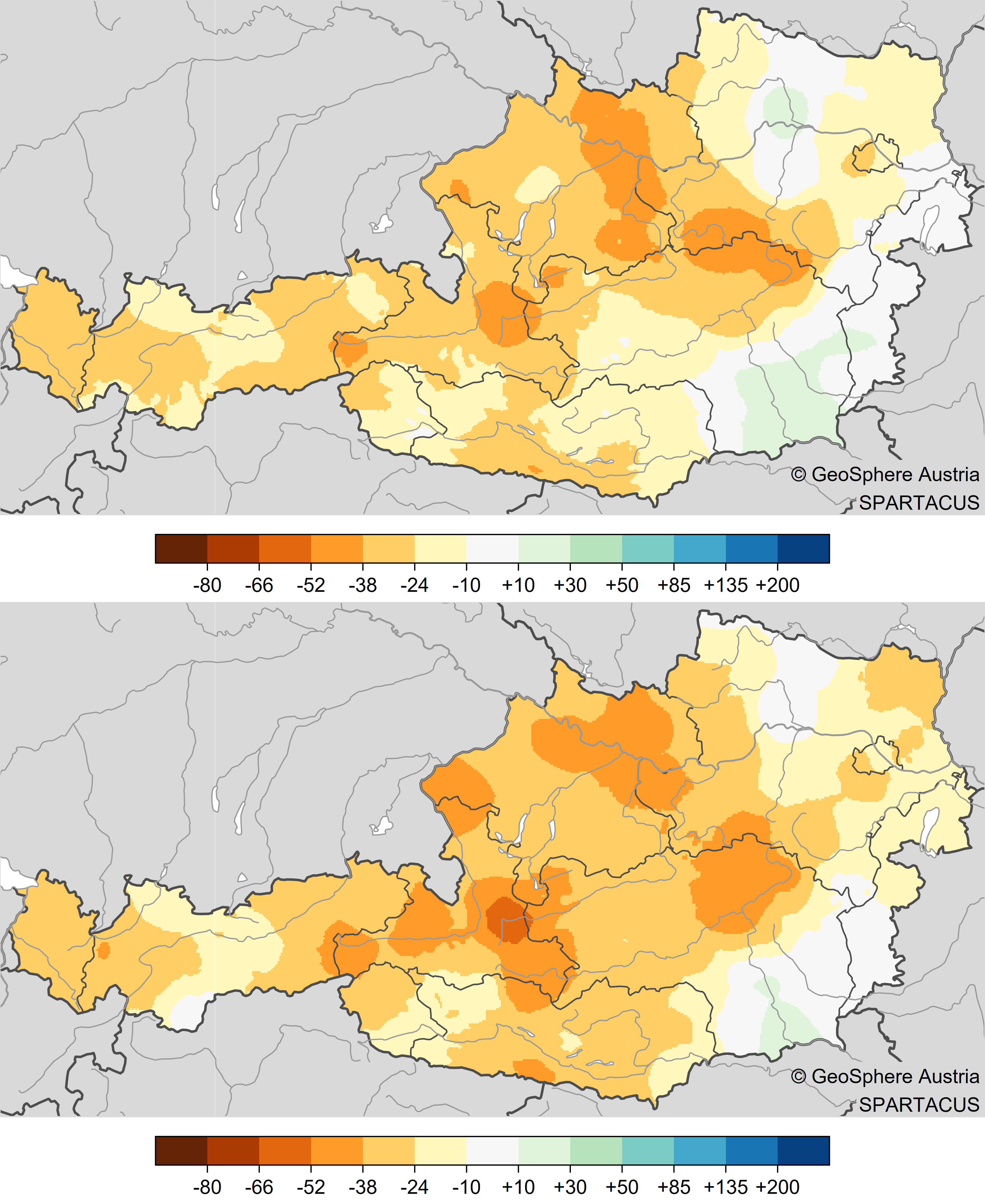
Precipitation in winter 2025/2026: deviation of precipitation from the mean: bottom image compared to the 1961–1990 mean, top image compared to the 1991–2020 mean. Evaluation with SPARTACUS data up to and including 26 February 2026. © GeoSphere Austria.
In the short term, heavy snowfall in some regions caused problems on the roads and with the electricity supply, and greatly increased the risk of avalanches. Overall, however, snowfall in winter 2025/26 was well below average at all altitudes.
A few examples of the total daily fresh snowfall:
- Vienna Hohe Warte: -18 per cent (33 cm this winter, average 40 cm for 1991-2020)
- Klagenfurt Airport: -63 per cent (18 cm this winter, average 48 cm)
- Innsbruck Airport: -29 per cent (52 cm this winter, average 73 cm)
- Rax (N, 1,547 m above sea level): -48 per cent (118 cm this winter, average 225 cm)
- Rudolfshütte (S, 2,317 m): -60 per cent (247 cm this winter, average 625 cm)
Translated with DeepL.com (free version)