
Earthquakes in July 2026
In July, six earthquakes were felt by the population in Austria. The epicentres were in Lower Austria, Upper Austria, Vorarlberg and Tyrol.
The epicentre of a weak earthquake with a magnitude of 0.7 was located near Kleinzell im Mühlkreis, Upper Austria (48.45°N, 14.01°E) at 00:35 CEST on 8 July. It was slightly felt by a few people at the epicentre; some were woken up and a rumbling sound was heard. The intensity reached 3 on the European Macroseismic Scale (EMS-98), which has 12 levels.
On 20 July at 23:15 CEST, a weak earthquake of magnitude 1.0 occurred approximately 5 km south-southeast of Hatting (Sellrain), Tyrol (47.24°N, 11.20°E). It was felt weakly by a few people in Hatting, where a rumbling sound and slight shaking were noticed. The intensity was 2 to 3 on the EMS-98 scale.
A strong earthquake with a magnitude of 4.4 struck large parts of eastern Austria at 01:59 CEST on the night of 24 July. The epicentre was located just under one kilometre south of the village Kurort Semmering, Lower Austria (47.64°N, 15.82°E); the relatively shallow focus is reported to be at a depth of six kilometres. Due to the shallow depth of the focus, the strong tremors – accompanied by loud rumbling noises – were frightening for some people in the vicinity of the epicentre. Many people were awakened from their sleep with a fright. Numerous objects were dislodged or toppled over; books and other items fell from shelves, and lamps swung violently. Slight damage to buildings was reported to the Austrian Seismological Service, mainly consisting of cracks in the plaster on internal and external walls, with small pieces of plaster falling in some cases. To date, the Seismological Service has received just under 900 reports via the online form and the ‘QuakeWatch Austria’ app from the federal states of Lower Austria, Styria, Burgenland, Vienna and Upper Austria. During a similar earthquake two years ago (on 1 February 2024, magnitude 4.5), around 3,400 reports were submitted by the public; following the earthquake on 30 March 2021 near Neunkirchen (magnitude 4.6), there were more than 10,000 reports. The earthquake on 24 July was felt in neighbouring countries, including Hungary, Slovakia, the Czech Republic and Slovenia. The provisional epicentral intensity reached at least 5–6 on the EMS-98 scale. As data collection has not yet been fully completed, we would like to note that this value may still change. There were only a few weak aftershocks. Only the aftershock on 24 July at 06:16, with a magnitude of 2.0, was felt by the public with an intensity of 3 on the EMS-98 scale.
A clearly perceptible earthquake was felt by numerous people on 24 July at 18:33 near Frastanz, Vorarlberg (47.21°N, 9.63°E). With a magnitude of 2.6, the tremors were at times frightening, with buildings shaking and objects moving slightly to clearly. The intensity reached 4 on the EMS-98 scale.
The epicentre of a minor earthquake with a magnitude of 1.8, which occurred on 30 July at 19:09 CEST, was located approximately 4 km east-northeast of Krems an der Donau, Lower Austria (48.43°N, 15.65°E). It was felt weakly by a few people at the epicentre, and a rumbling sound was heard. The intensity reached 3 on the EMS-98.
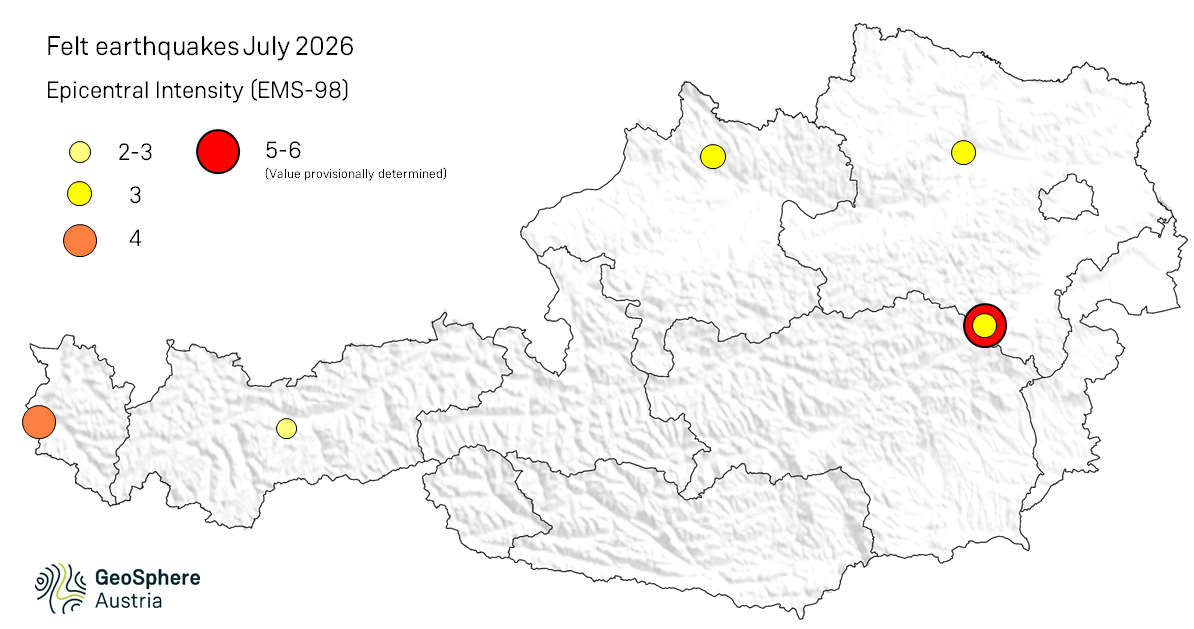
Earthquakes_July_2026.png
Epicenters and intensities of the earthquakes felt in Austria in July 2026. © GeoSphere Austria.
Excerpt from the short form of the 12-level European Macroseismic Scale 1998, based on Mercalli-Sieberg.
- Degree 2 – Scarcely: The tremor is felt only by a very few individuals at rest and in an especially receptive position indoors.
- Degree 3 – Weak: The earthquake is felt indoors by a few. People at rest feel a swaying or light trembling. Hanging objects swing slightly.
- Degree 4 – Largely observed: The earthquake is felt indoors by many and felt outdoors only by very few. A few people are awakened, the vibration is moderate, slight trembling of the building or room. Glasses, windows and doors rattle, light furniture shakes visibly.
- Degree 5 – Strongly felt: The earthquake is felt indoors by most, outdoors by few. A few people are frightened and run outdoors. Many sleeping people awake. Observers feel a strong shaking or rocking of the whole building, room or furniture. Small objects may be shifted or fall down. Doors and windows swing open or shut. Hairline cracks appear in a few buildings, particularly those prone to damage.
- Degree 6 – Slightly damaging: A few persons lose their balance. Many people are frightened and run outdoors. Small objects of ordinary stability may fall and furniture may be shifted. In few instances dishes and glassware may break. Many buildings suffer minor damage, such as cracks in the plaster, and in some cases, deep cracks in the walls also occur.
UTC (Universal Time Coordinated) = GMT (Greenwich Mean Time) Data for worldwide earthquakes according to U.S. Geological Survey M: Magnitude (logarithmic energy scale) Information provided without guarantee
Seismological Service of Austria - GeoSphere Austria Hohe Warte 38, A-1190 Vienna Tel. +43 1 36026 2508 E-Mail: seismo@geosphere.at