
Alpine Climate: Review of the 2025/26 Winter Half-Year
The German Weather Service, MeteoSwiss and GeoSphere Austria publish a joint assessment twice a year on the current climate in the Alpine region and how it compares with long-term trends. The report on the sunny, relatively mild and very dry 2025/26 winter half-year has just been published.
The period from November 2025 to April 2026 was characterised by plenty of sunshine, relatively mild temperatures and very low precipitation levels. As in the previous year, there was significantly less snow compared to the 1991–2020 climate average. The average snow depths in the DACH Alpine region during the 2025/26 winter half-year are among the five lowest since 1991. The winter half-year was characterised by a combination of above-average temperatures and dry conditions. With a temperature 1.1 degrees Celsius above the climate average (1991–2020), the warming trend continued, although it was slightly less warm than the previous winter half-year (+1.6 °C).
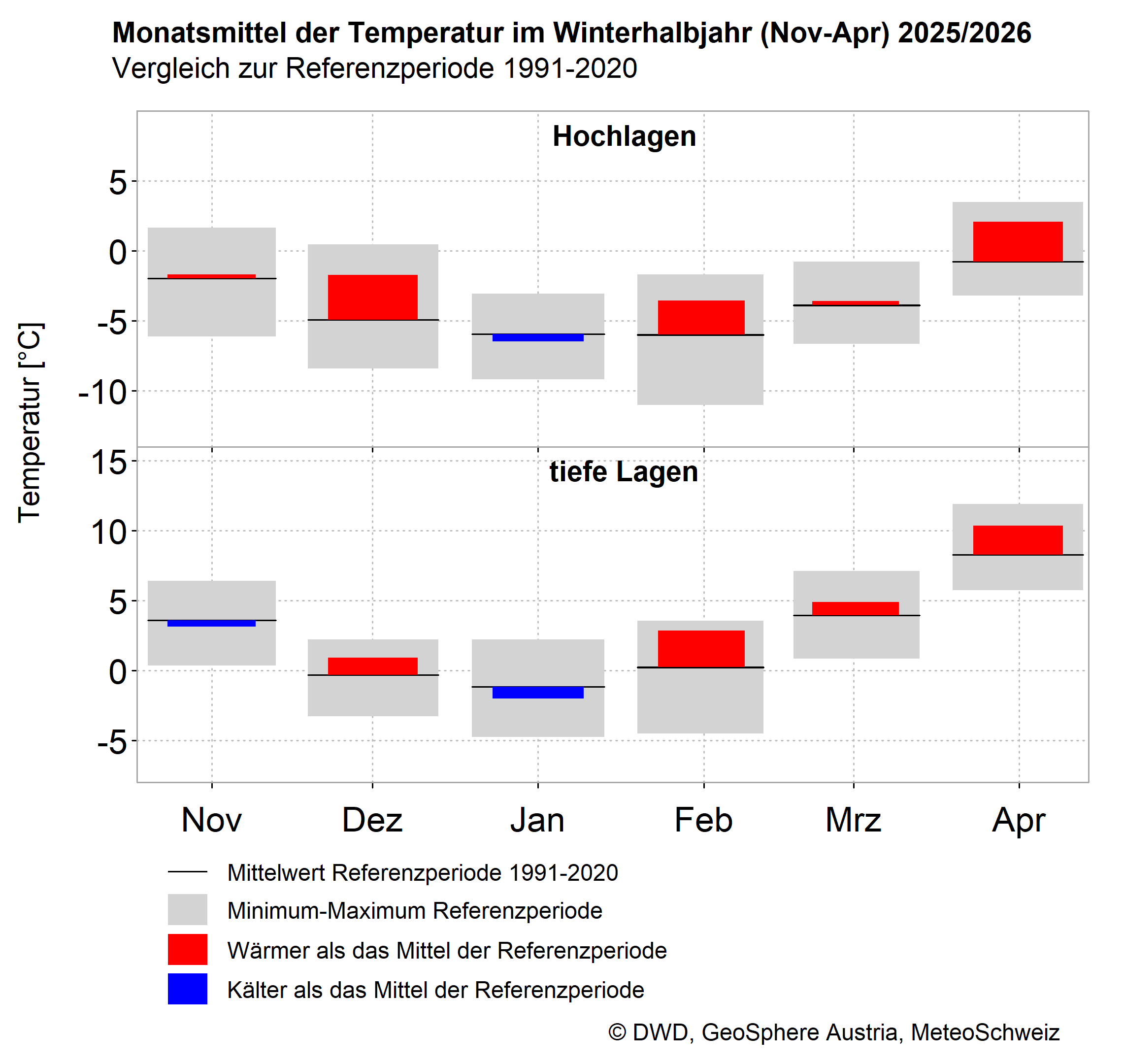
Alpine climate_winter25-26_temp.png
Alpine climate in Germany, Austria and Switzerland: Monthly deviations during the 2025/26 winter season (November to April) compared with the 1991–2020 reference period for temperature (at both high and low altitudes). © DWD, GeoSphere Austria, MeteoSchweiz.
In the Northern Alps, it was the second driest winter since 1991; in the Southern Alps, it was the driest on record. There were particularly large deficits from December to early February (down to minus 70 per cent). During this crucial phase of the winter, substantial snowfall was almost entirely absent. From 10 February, the prevailing dry spell came to an end for the time being, and by 24 February, enough precipitation had fallen to result in a positive monthly balance in almost all Alpine regions of the DACH area. In Valais, Graubünden, East Tyrol and from the Lechtal Alps to the Chiemgau Alps, there was a precipitation surplus of 75 to 150 per cent. Yet even these amounts were not sufficient to offset the overall deficit. This was compounded by a dry April. Consequently, snow depths for the 2025/26 winter season are among the lowest in the historical record.
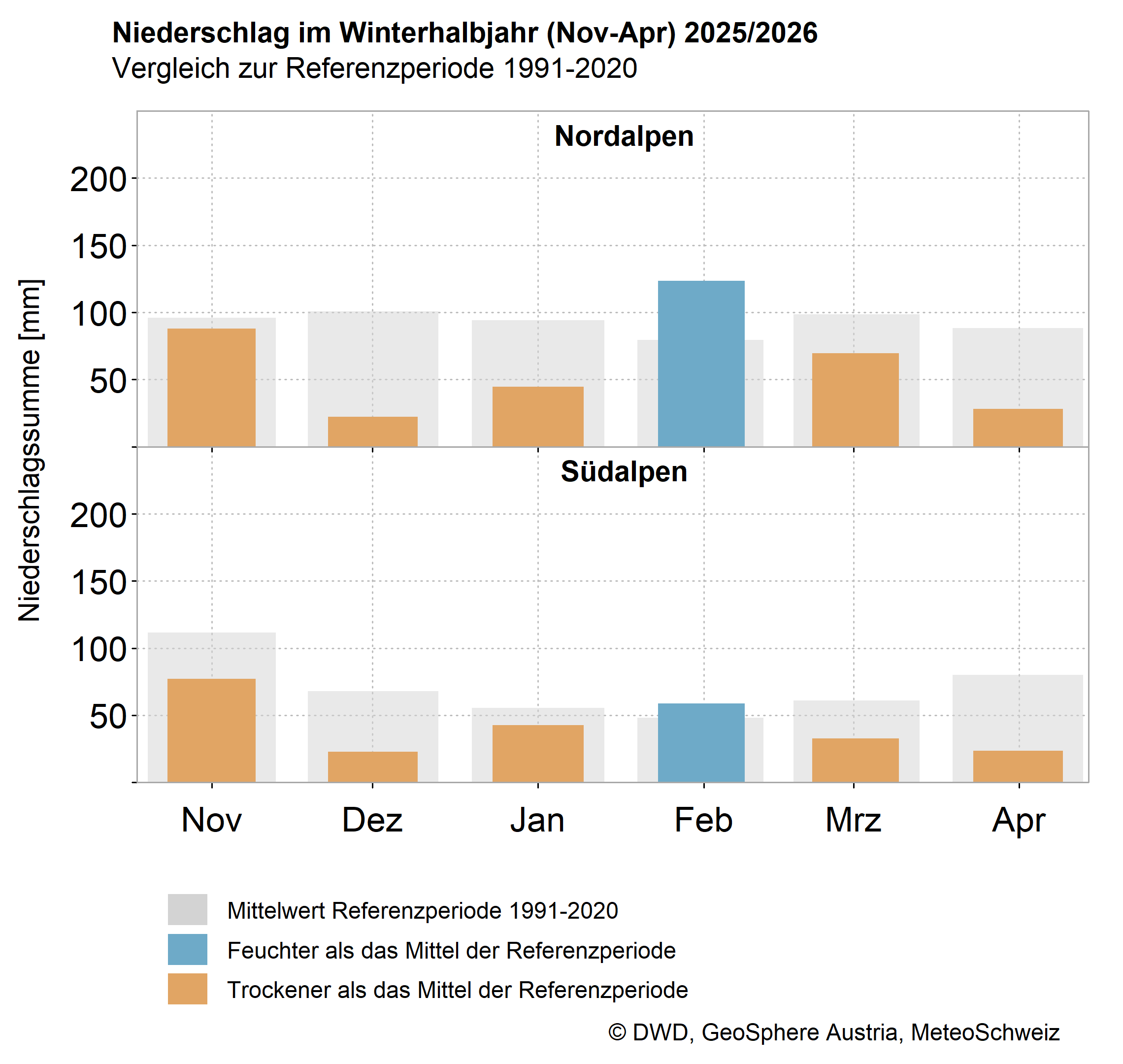
Alpineclimate_winter25-26_precipitationNiederschlag.png
Alpine climate in Germany, Austria and Switzerland: Monthly deviations in the winter half-year 2025/26 (November to April) compared to the reference period 1991–2020 for precipitation (Northern and Southern Alps respectively). © DWD, GeoSphere Austria, MeteoSchweiz.
Last winter also saw a number of temperature inversions. This means that temperatures in the valley are lower than at higher altitudes. One indicator of temperature inversions is days with fog or high fog over the lowlands. So whilst visibility on the mountains is excellent, the air is clear and the sky is blue (albeit with no precipitation), it is cold and overcast in the valley. Added to this is the fact that pollutants accumulate in the air, leading to an increased risk of respiratory and cardiovascular diseases. The winter halves of 2024/25 and 2025/26 saw a higher number of days with fog or high fog in some regions compared to the past 30 years or so. The Klagenfurt/Villacher Alpe pair of measuring stations recorded 27 and 30 such days respectively in the past two winters. The long-term average is 17.3 days.
When solar storms strike the Earth’s magnetic field, geomagnetic storms can occur – with consequences that are both visible and technical. Although the peak of the current solar cycle (the turn of the year 2024/25) has already passed, increased solar activity was still noticeable in the Alpine region during the past winter half-year. Between 5 and 9 November, several solar storms reached Earth. On 11 November, another coronal mass ejection followed, followed on 12 November by an even stronger event associated with a very intense solar flare. The peak of the season was reached on 19 January 2026. A particularly powerful eruption on the Sun hurled a fast coronal mass ejection towards Earth, triggering a severe geomagnetic storm. Impressive Northern Lights were also visible in the Alpine region that night. On 30 March 2026, another geomagnetic storm occurred, though it was significantly weaker than the one in January.
The Alpine region is more severely affected by the consequences of human greenhouse gas emissions than other regions or natural areas, the authors of the Alpine Climate Report emphasise: ‘In this highly sensitive area, the effects of climate change are clearly visible. There is less and less snow, the glaciers are losing significant mass, and in summer, heat is becoming an ever-greater problem even at higher altitudes. These changes do not stop at national borders and affect the entire Alpine region equally. This makes cross-border information on climatic developments in the Alpine region all the more important.’
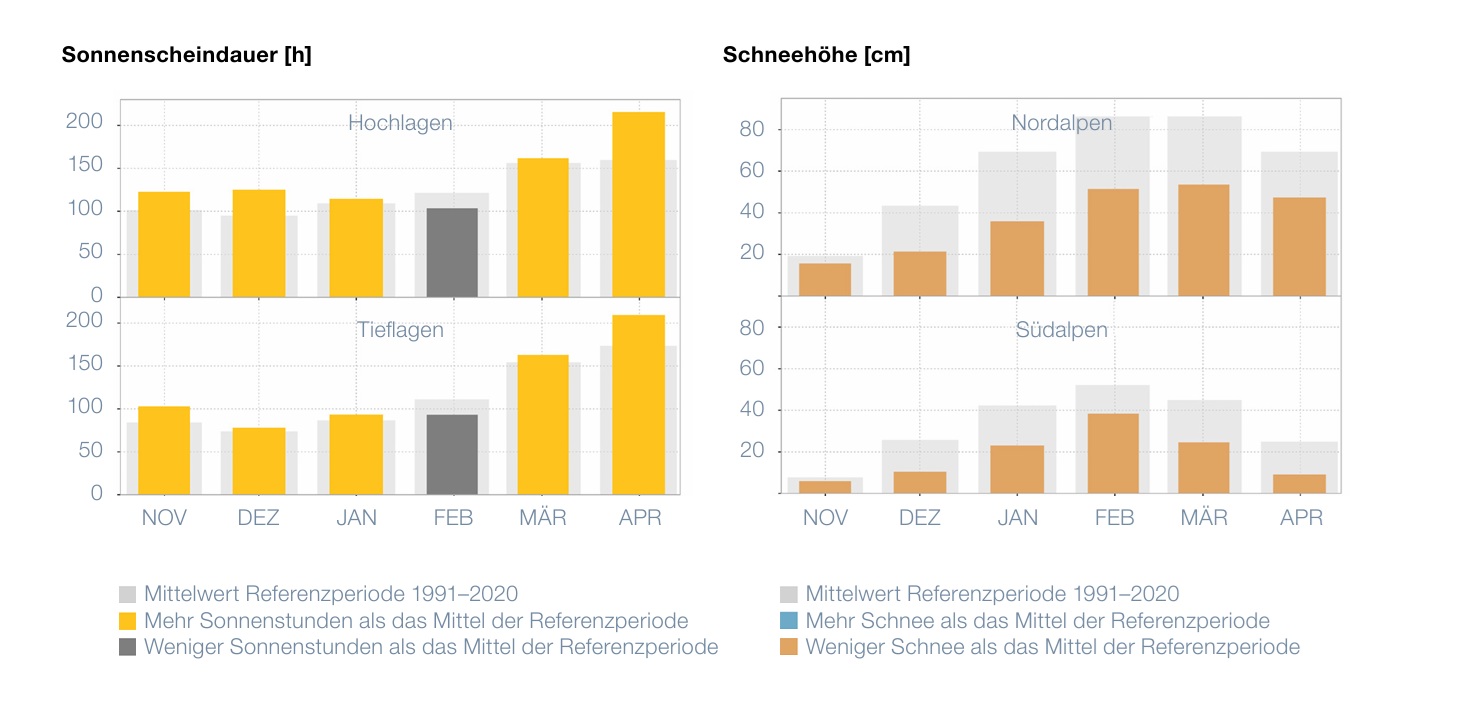
Alpine climate_winter25-26_sun_snow.jpg
Alpine climate in Germany, Austria and Switzerland: Monthly deviations during the winter half-year 2025/26 (November to April) compared to the reference period 1991–2020 for snow depth and sunshine. © DWD, GeoSphere Austria, MeteoSchweiz.
Measurements began in September 1886 at the Sonnblick Observatory of GeoSphere Austria (3,106 metres above sea level). The German Weather Service’s weather station on the Hohenpeißenberg (970 metres above sea level) began operations in January 1781, and that on the Zugspitze (2,962 metres above sea level) in July 1900. MeteoSwiss has been taking measurements on the Säntis (2,502 metres above sea level) since September 1882.
Translated with DeepL.com (free version)