
Turning knowledge into action in the face of natural hazards
Disaster prevention and management in agriculture and forestry were the main themes of the 8th Natural Hazards Conference, which took place this year in Ebersdorf, Styria, in the Kaindorf Ecoregion from 12 to 14 October. The conference centred on the growing challenges posed by storms, heavy rain, flooding, landslides, drought and forest fires, as well as successful solutions for local authorities, businesses and emergency services.
One billion euros – this was the figure quoted by the hail insurance company for the damage caused to domestic agriculture by the drought during the extreme summer of 2026. For Austria, the consequences of man-made climate change are disproportionately severe: Whilst the global average temperature has risen by around 1.4 degrees Celsius since pre-industrial times, Austria has recorded a temperature rise of around 3.1 degrees Celsius over the same period. This trend is increasingly leading to extreme events with a wide range of impacts – in Austria, for example, more frequent squalls and windthrow, hail and damage to agriculture, debris flows and flooding.
‘Austria has outstanding scientific institutions, effective early-warning systems and a wealth of experience in dealing with natural hazards,’ emphasised Andreas Schaffhauser, Scientific Director-General of GeoSphere Austria and Chair of the Austrian Platform for Disaster Risk Reduction (ASDR). Speaking to the 140 experts attending the three-day event in Styria, he stressed that the dangers and consequences of man-made climate change can only be tackled by working together. For Schaffhauser, the transfer of knowledge is particularly crucial. ‘The best scientific findings are of little use if they are not put into practice. We must forge even closer links between research, public administration, emergency services and local authorities, and turn knowledge into action,’ urged Andreas Schaffhauser.
‘Particularly in light of climate change, we must set the right course today to protect our forests and our population as effectively as possible. With dynamic forest typology, we in Styria have a valuable tool that shows which tree species can thrive in which locations, even under the climate conditions of the future. We must consistently put this knowledge into practice. At the same time, we are strengthening flood defences as well as torrent and avalanche control measures. Proactive protection is an investment in the future of our region,’ said Styrian Regional Councillor Simone Schmiedtbauer, who opened the event together with Schaffhauser, the Climate and Energy Fund and representatives from the region.
Co-organiser Margit Schlagbauer, KLAR! manager at the Kaindorf Ecoregion, added: ‘As a KLAR! region, we are constantly seeking solutions to the challenges posed by climate change and increasing natural hazards. That is why we wholeheartedly support events such as the Natural Hazards Conference. We are particularly pleased that we have succeeded in bringing this important event to Ebersdorf in Styria. Our region, in particular, has experienced in recent years just how important prevention, adaptation and cooperation are.’
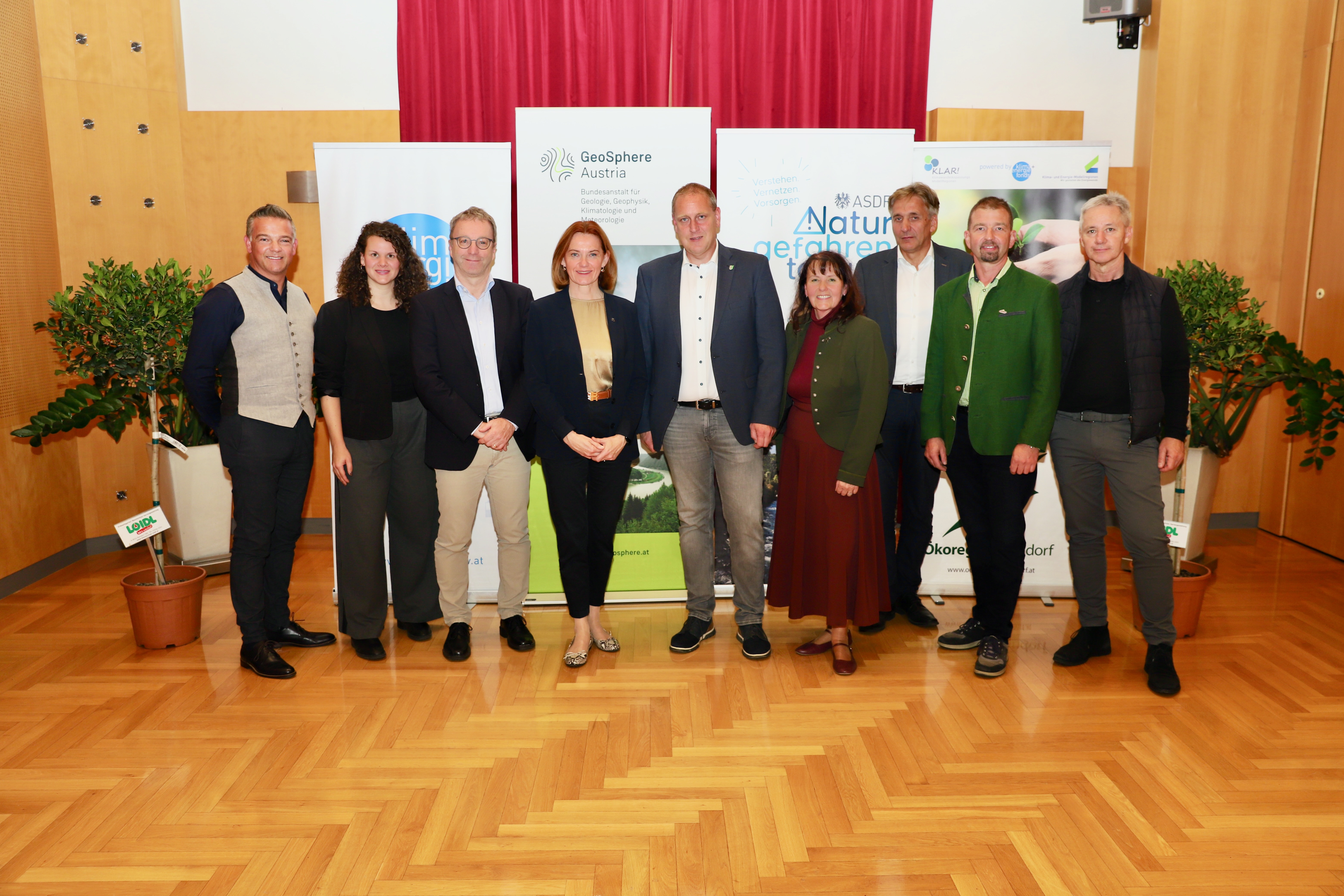
Naturgefahrentagung_2026.jpg
From left to right: Wolfgang Fank (Kirchberg am Walde College of Agriculture and Forestry), Lisa Humer (Climate and Energy Fund), Andreas Schaffhauser (GeoSphere Austria), Simone Schmiedtbauer (Provincial Councillor), Dietmar Lang (Mayor of Ebersdorf), Margit Schlagbauer (Kaindorf Ecoregion), Werner Schwab (Mayor of Sölk), Robert Stelzer (Deputy Mayor of Gasen) and Rainer Dunst (Kaindorf Ecoregion). © Ökoregion Kaindorf.
This year, particular emphasis was also placed on involving the next generation. Pupils from the Kirchberg am Walde Agricultural College took part and were able to gain first-hand insight into current challenges and potential solutions for dealing with natural hazards and climate change. As future farmers and foresters, they will play a key role in shaping our cultural landscape and safeguarding the supply of regional food. This makes it all the more important to equip them today with the necessary knowledge and practical tools for climate-resilient and sustainable farming. The conference offered valuable insights into this and highlighted how precautionary measures, innovation and adapted farming methods can help to safeguard agriculture and food security in the future.
The Natural Hazards Conference is regarded as a key forum for dialogue between academia and practitioners. GeoSphere Austria is responsible for coordinating the event and for the national implementation of the activities of the United Nations Office for Disaster Risk Reduction. The aim is to work with the KLAR! regions to reach out to local communities, where the population is ultimately affected by extreme events and decisions must be taken swiftly.
Under the guiding principle ‘Communities learn from communities’, scientific findings are linked with practical experience, successful solutions are highlighted, and networking between communities, emergency services, local authorities and research organisations, as well as farmers, foresters and regional managers, is strengthened.
Translated with DeepL.com (free version)