
Research project highlights the need for action in the Wachau wine-growing region
Winegrowing in the Wachau region, with its famous stone terraces, is a UNESCO World Heritage Site. However, human-induced climate change is affecting the region more severely than average. The situation for winemakers in the Wachau is serious; drought and rising temperatures, in particular, are becoming an increasingly serious problem. In a research project commissioned by the “Wachau Regional Wine Committee,” GeoSphere Austria scientists from the fields of geology, climatology, and geophysics spent three years trying to find answers to the questions posed by the Wachau’s winemakers. The research findings were jointly presented today, Monday, in Dürnstein.
‘For centuries, the winemakers of the Wachau have relied on their generational knowledge and regional expertise. With this project, we are supplementing that knowledge with our scientific expertise, enabling us to provide the foundation for highly relevant decisions,’ explains Andreas Schaffhauser, Scientific Director General of GeoSphere Austria.
The project benefited from close collaboration with local winemakers. Anton Bodenstein, Chair of the ‘Wachau Regional Wine Committee’: ‘As Wachau winemakers, we feel the effects of global warming directly in our vineyards—our vines are increasingly confronted with heat, drought stress, and altered soil processes. To safeguard the typical terroir and style of Wachau wines in the long term, we need sound scientific data in addition to our practical experience. This research project provides us with crucial insights that will enable us—and future generations—to address the challenges of climate change in a targeted manner.’
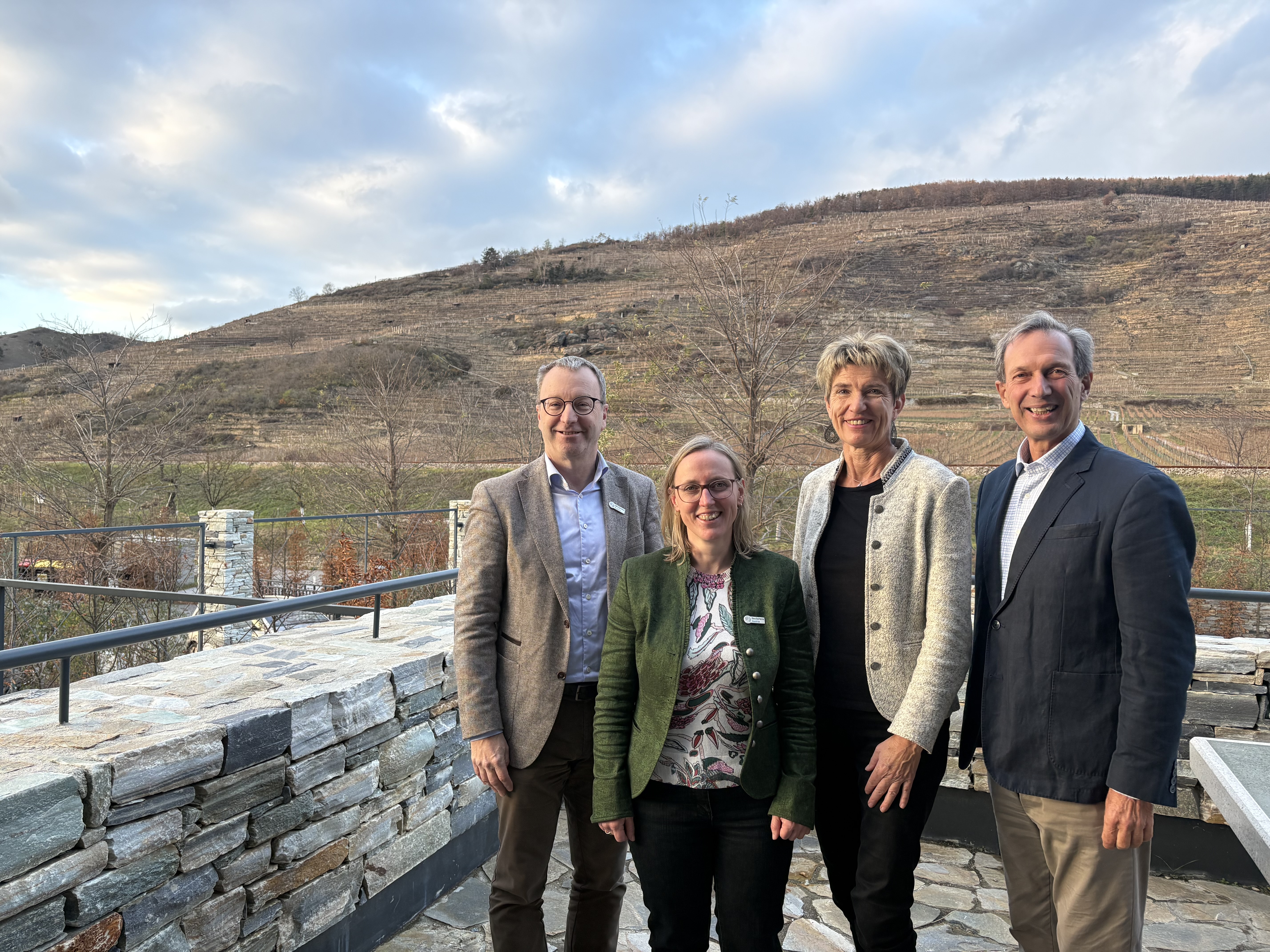
Wachau_participants_press conference
Participants at the press conference held during the presentation of the research findings on September 23, 2026, in Dürnstein. From left to right: Andreas Schaffhauser (Scientific Director General of GeoSphere Austria), Ingrid Schlögel (Project Manager, GeoSphere Austria), Martina Diesner-Wais (Member of the National Council), and Anton Bodenstein (Chair of the Wachau Regional Wine Committee, winemaker). © GeoSphere Austria/Siquans-Egger.
The average temperature around Krems has risen by two degrees since the 1950s. Various climate scenarios have been modeled for the future. All scenarios show that, despite precipitation levels expected to remain constant, the climatic water balance will deteriorate due to increasing evaporation. Heat and drought stress are becoming ever greater challenges for wine yield and quality. The increase in extreme events—especially droughts—will also pose challenges for viticulture in the Wachau region.
In addition to atmospheric changes, the subsoil plays a particularly important role. Even more detailed geological mapping at a scale of 1:10,000 provides insight into the exact composition of the subsoil and thus offers a new foundation. The map documents the various rock types and their evolutionary history, which dates back more than a billion years. After all, it matters greatly to the vines in which type of soil they take root. The different source rocks influence soil formation, the availability of minerals, and the soil’s ability to store water.
Particular attention was paid to the uppermost sedimentary layers—especially the loess deposits—and their thickness. ‘Seismic surveys reveal previously insufficiently understood subsurface structures—with deep measurements reaching down to about 250 meters,’ explains Ingrid Schlögel, project manager and head of the Department of Near-Surface Geophysics at GeoSphere Austria. ‘The nature of the subsurface influences root penetration and water availability.’
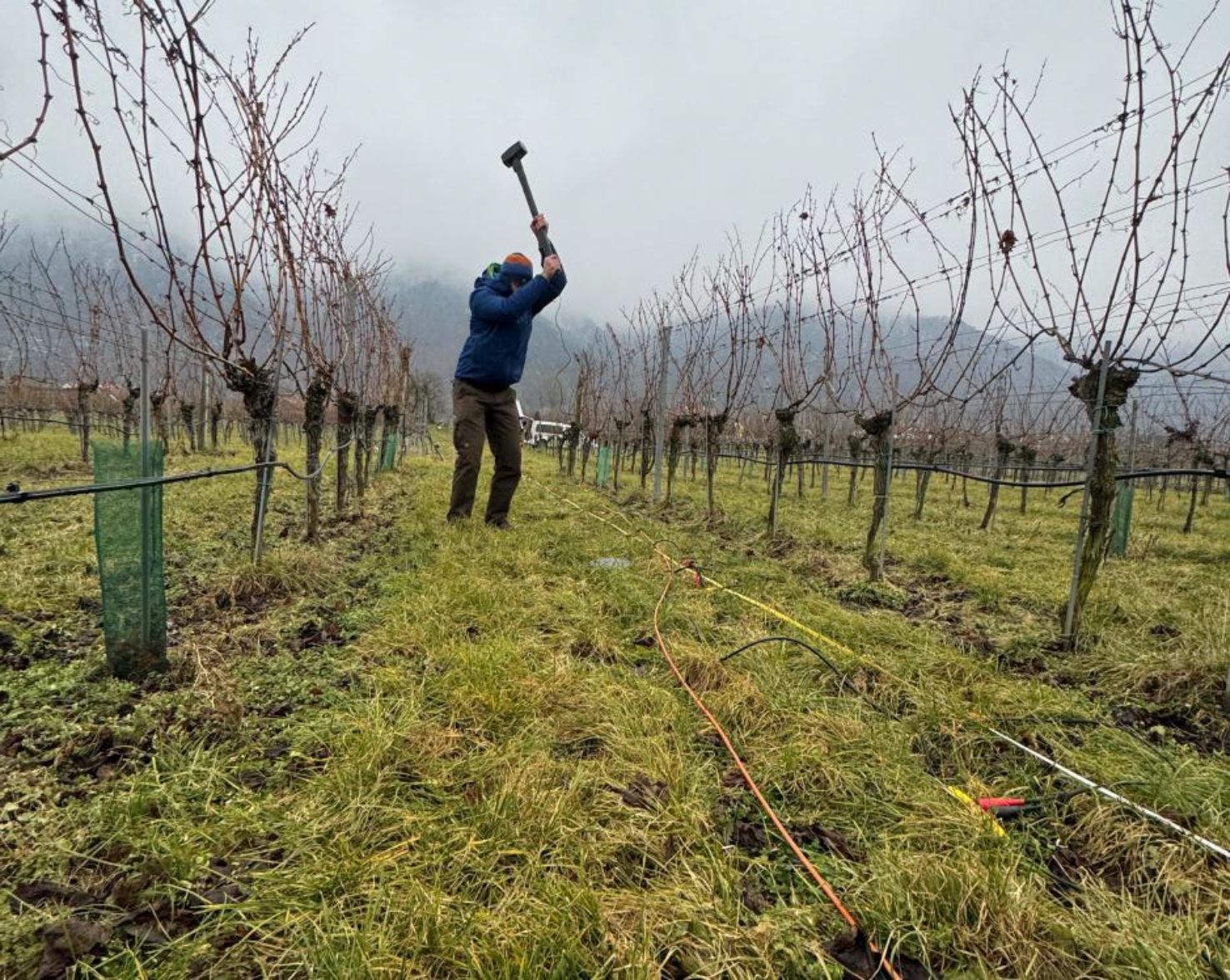
Wachau_Seismic measurements.jpg
Creating a seismic profile in a vineyard in the Wachau region. © GeoSphere Austria.
Soil moisture and soil temperature were measured at four depths across ten locations. Result: Precipitation and irrigation were found to have different effects on the soil water balance. What’s more, the effects of irrigation were sometimes detectable down to a depth of 60 centimeters and had a stronger impact than precipitation. The measurements are intended to help winemakers develop a needs-based irrigation strategy. In addition, drones provided radiometric and thermal data on the diverse soil materials. An intriguing finding: Dry stone walls significantly increase soil temperature through their heat radiation. Soil management—specifically, cooling through long grass—plays a central role in this context. Within a single vineyard site, there are varying geological conditions and temperature patterns across vineyards, vegetation, and terrace structures.
The detailed descriptions now available support tailored site planning when selecting grapevines. The effects of cold air currents in the side valleys that flow toward the Danube have a greater impact than the Danube current itself. For winemakers, this means that a vineyard’s location influences its nighttime temperature conditions—including the risk of late frost. Conclusion: The GeoSphere Austria research findings provide information on what measures need to be taken at specific locations to make the vines as resilient as possible to extreme temperatures.
- The Wachau region is disproportionately affected by climate change
- Water balance has deteriorated despite consistent precipitation levels
- Frost nights will become less frequent but more dangerous in the future
- New geological mapping enables improved site planning for vineyards
- Irrigation and soil management are essential for future viticulture
- Terraced landscapes significantly increase soil temperature
- Cold air currents from the side valleys will be more significant for the future than those from the Danube River
Translated with DeepL.com (free version)