
GeoSphere Austria: Warmest August in 260 years of recorded history
Preliminary August summary from GeoSphere Austria: A new all-time temperature record of 41.2 degrees and three consecutive days with temperatures of 40 degrees or more. Record figures were also recorded for the number of hot days. Rainfall remained very low in the south and east of the country, with a precipitation deficit of between 50 and 70 per cent in these regions.
August 2026 was the hottest eighth month of the year in Austria’s 260-year history of weather records. ‘Weather patterns that transported subtropical air masses to Central Europe predominated. Combined with a prevailing high-pressure system, this resulted in predominantly sunny weather with little rainfall, which led to exceptionally high to extremely high temperatures, particularly in the first half of the month,’ explains climatologist Alexander Orlik from GeoSphere Austria. The peak occurred on 3, 4 and 5 August – on each of these three days, temperatures reached the 40-degree mark. On 5 August, the GeoSphere Austria monitoring station in Bad Deutsch-Altenburg (Lower Austria) recorded 41.2 degrees, the highest temperature ever recorded in Austria. The Vienna-Stammersdorf monitoring station recorded 41.0 degrees on both 4 and 5 August. The average air temperature in August 2026 was 3.1 degrees above the climate average for the years 1991 to 2020 and 4.9 degrees above the climate average for 1961 to 1990. In the mountains, temperature anomalies reached 3.3 and 5.1 degrees respectively.
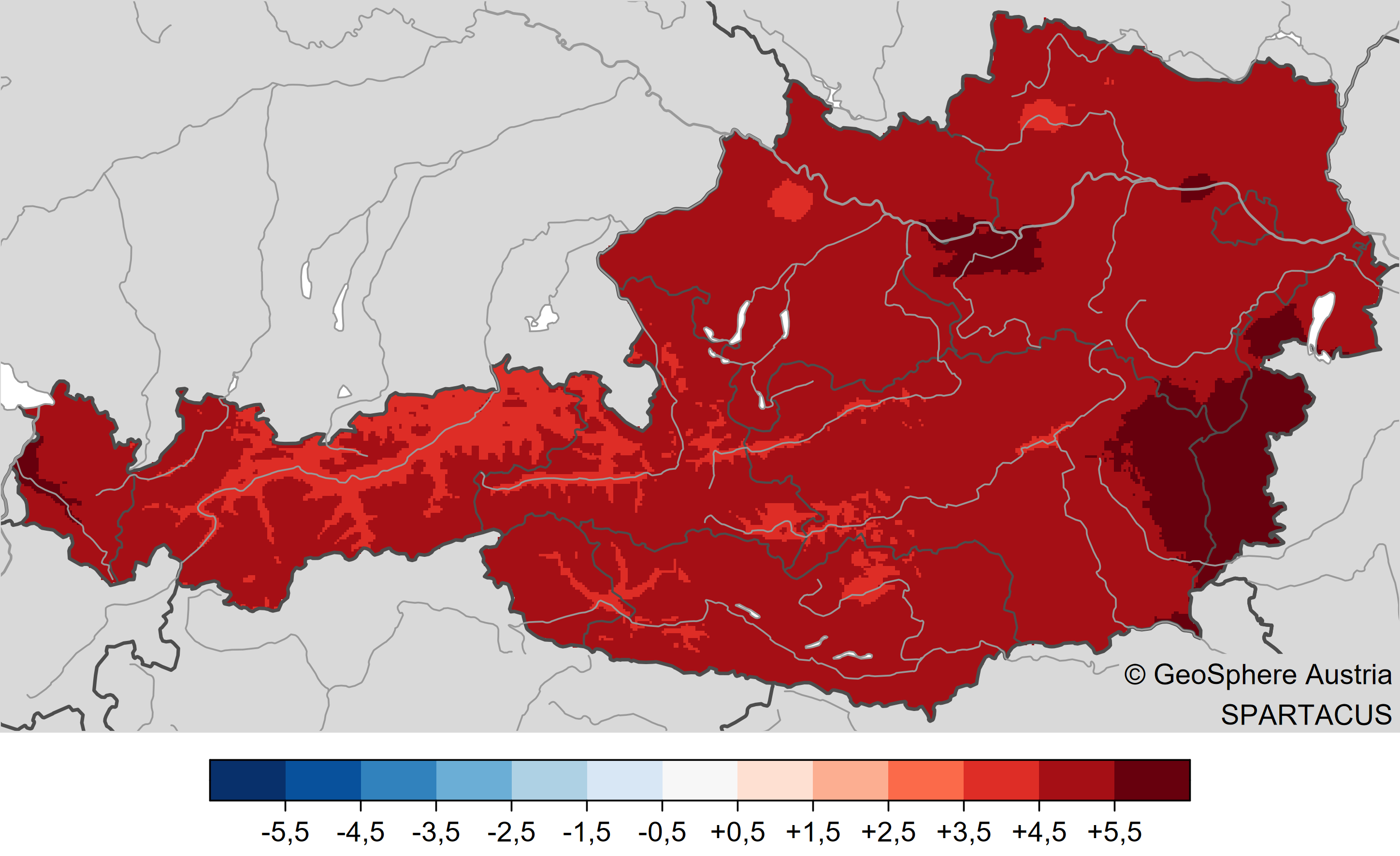
August2026_temp_compare_1961-1990.png
Temperature in August 2026 compared with the long-term average for 1961 to 1990. © GeoSphere Austria.
August also saw record-breaking figures for the number of hot days: at altitudes below 500 metres above sea level, there was an area-weighted average of 17 hot days – a 200 per cent increase on the climate average. Between 500 and 1,000 metres, the increase was as high as 330 per cent, with eleven hot days. Some monitoring stations recorded new records. These include Bregenz (V, 16 hot days compared with twelve in 1992), Feldkirch (V, 16 compared with 14 in 1992) and Vienna-Mariabrunn (W, 21 compared with 20 in 2003). In Bad Radkersburg, there were as many as 24 hot days. However, there were also ‘outliers’ in the opposite direction: for instance, the GeoSphere Austria instruments at the Schwarzau/Freiwald station (Upper Austria, 788 m) recorded a temperature of minus one degree on 24 August.
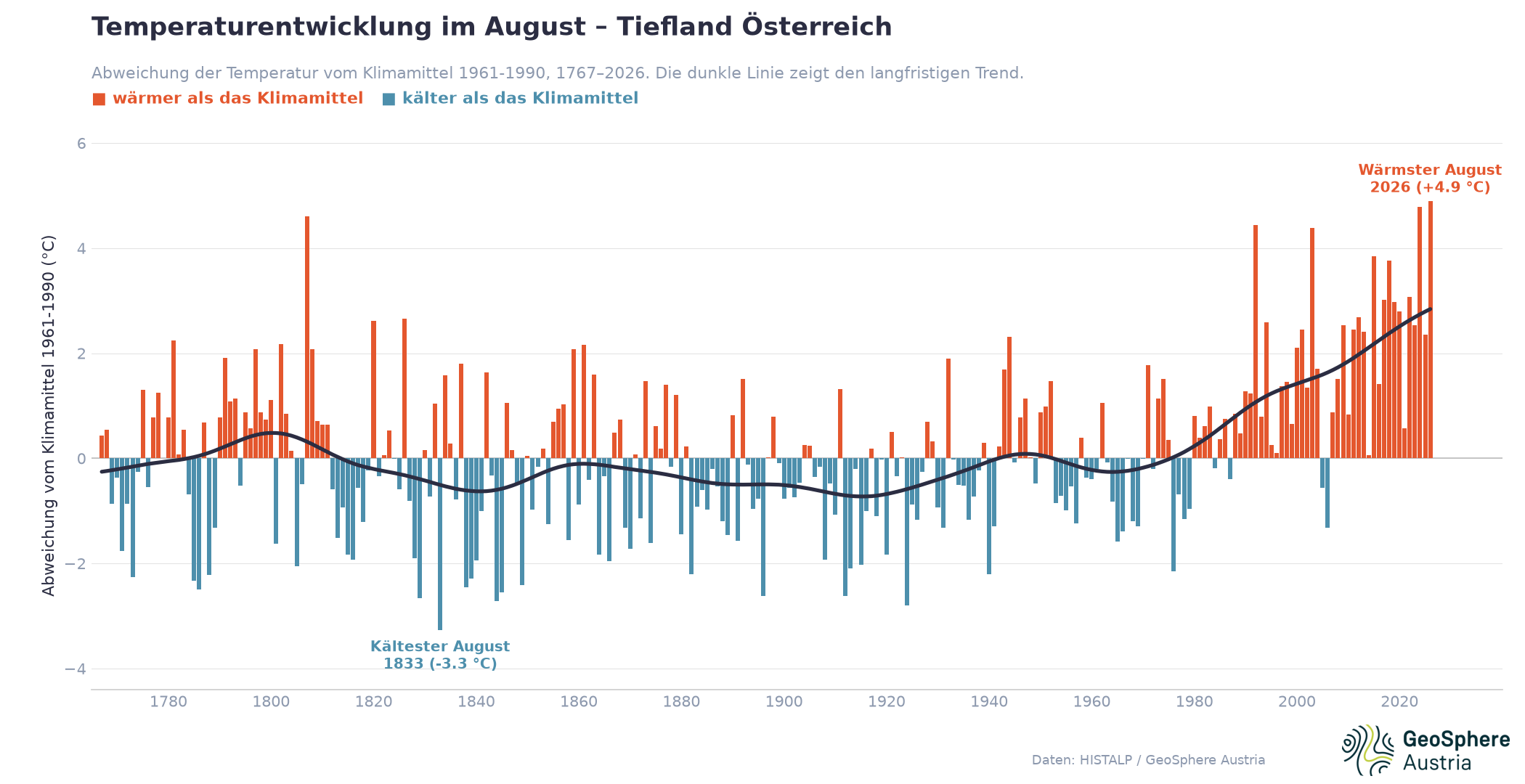
August2026_temp_compare_1961-1990_lowlands.png
Temperature trends (lowlands) in August compared with the long-term average from 1961 to 1990. © GeoSphere Austria.
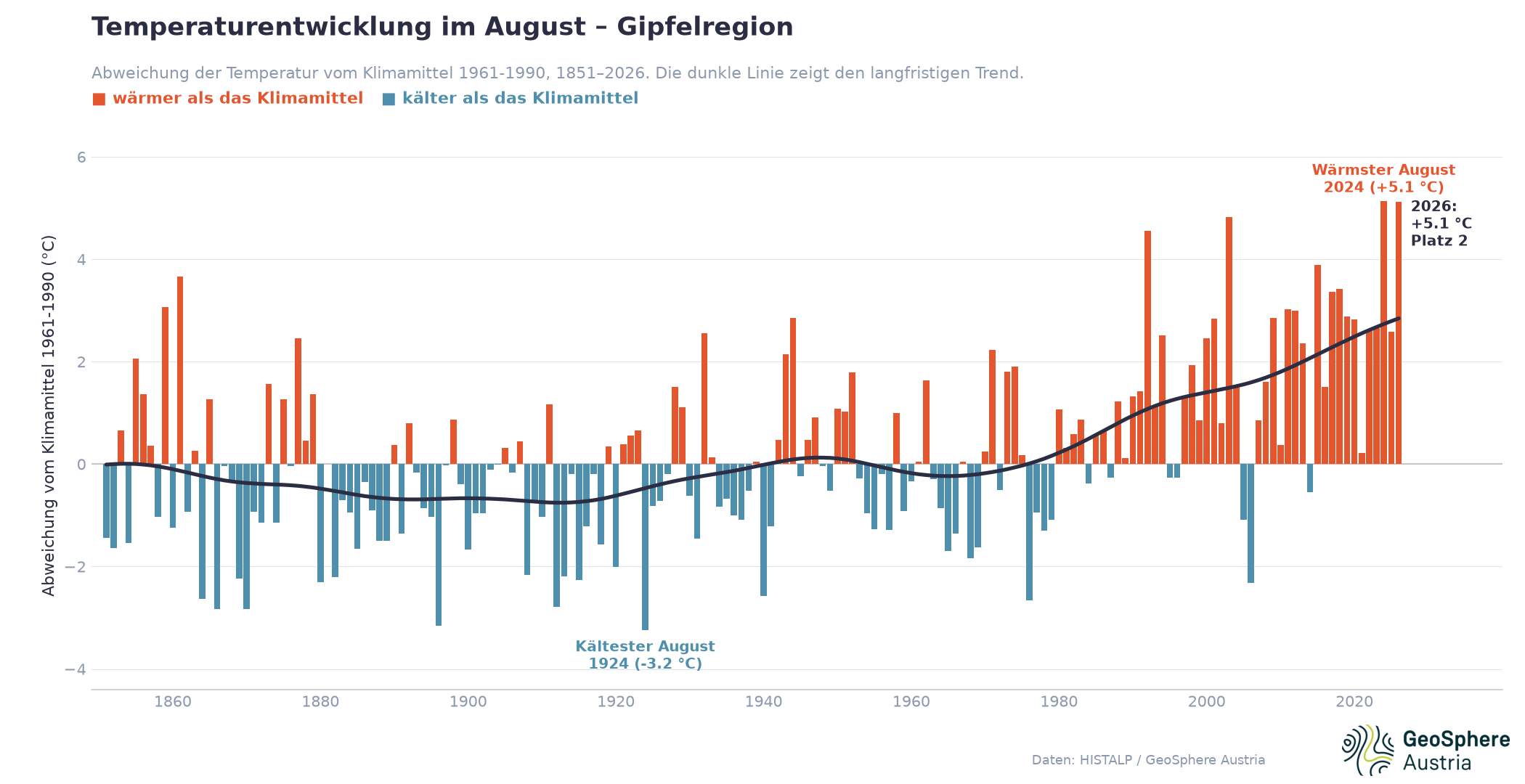
August2026_temp_compare_1961-1990_mountains.png
Temperature trends (mountain peaks) in August compared with the long-term average for 1961 to 1990 © GeoSphere Austria.
Whilst parts of western Austria saw more rainfall in August than the long-term average for 1991 to 2020, the south and, above all, the east of the country remained far too dry once again. ‘The drought that has prevailed here since the start of the year has therefore worsened further,’ explains Orlik. ‘This is now the third August in a row that has been significantly too dry.’ From the Arlberg to the Pinzgau, as well as in East Tyrol and Upper Carinthia, rainfall levels were relatively balanced, with deviations from the climate average ranging from minus 15 to plus 15 per cent. By contrast, large parts of Lower Austria, Vienna, Burgenland and the north-western parts of Styria (Hochschwab, Koralpe) recorded a rainfall deficit of between 50 and 70 per cent. The driest place in Austria in August 2026 was Langenlebarn in the Tullnerfeld (Lower Austria) with 19 millimetres of rainfall, corresponding to a deficit of 75 per cent.
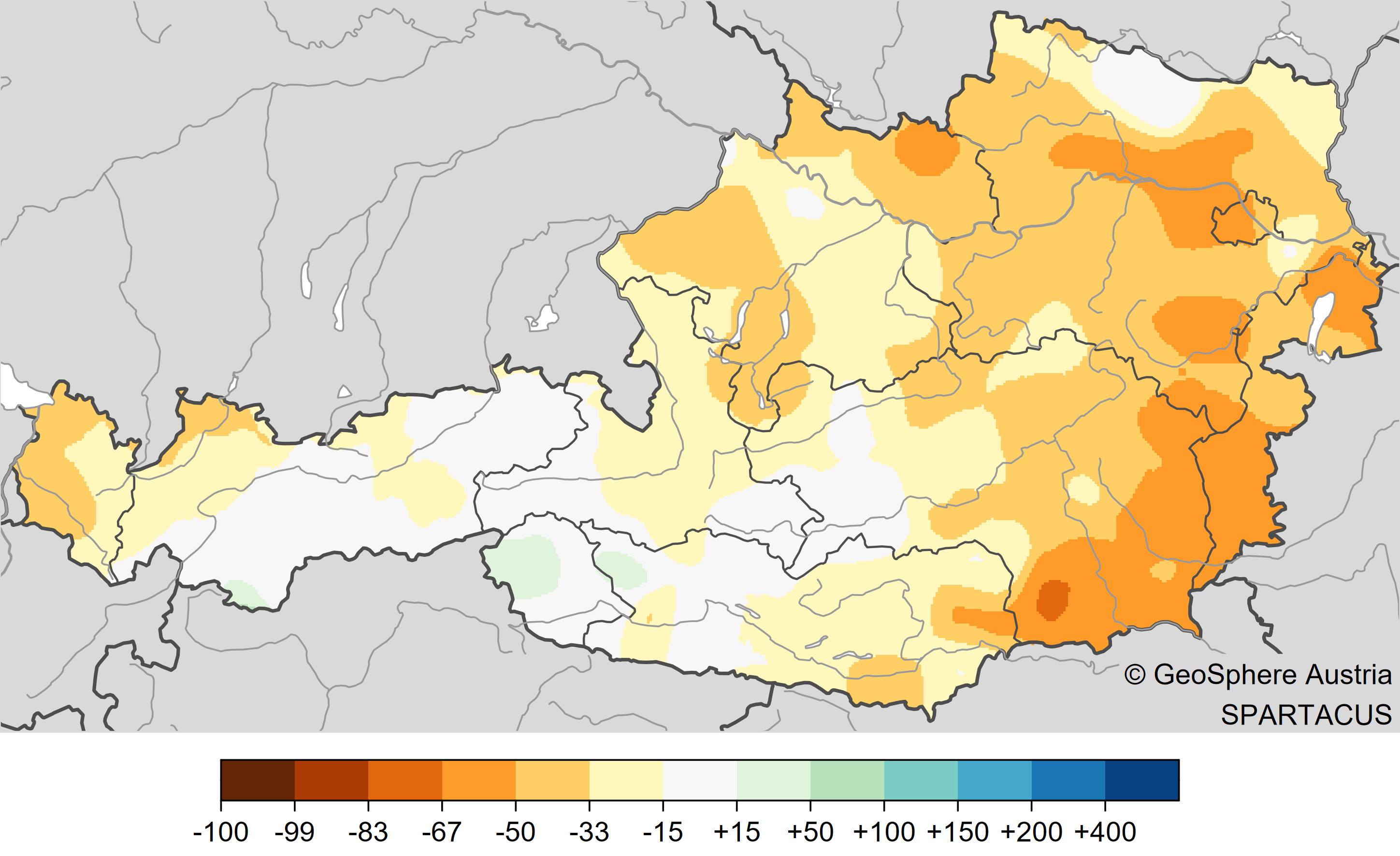
August2026_precipitation_compare_1961-1990.png
Precipitation in August 2026 compared with the long-term average from 1961 to 1990. © GeoSphere Austria.
In August, the black elderberries and rowanberries began to ripen. This year, the onset of ripening for black elderberries was seven days earlier than the Austria-wide average compared with the long-term average from 1991 to 2020, placing it 11th in the series of observations dating back to 1926. Compared with the average from 1961 to 1991, the onset of ripening for black elderberries was around 23 days earlier. The start of ripening for rowan berries was one day earlier than the 1991–2020 average. Due to this year’s drought, the elderberries and rowan berries have withered in some places.
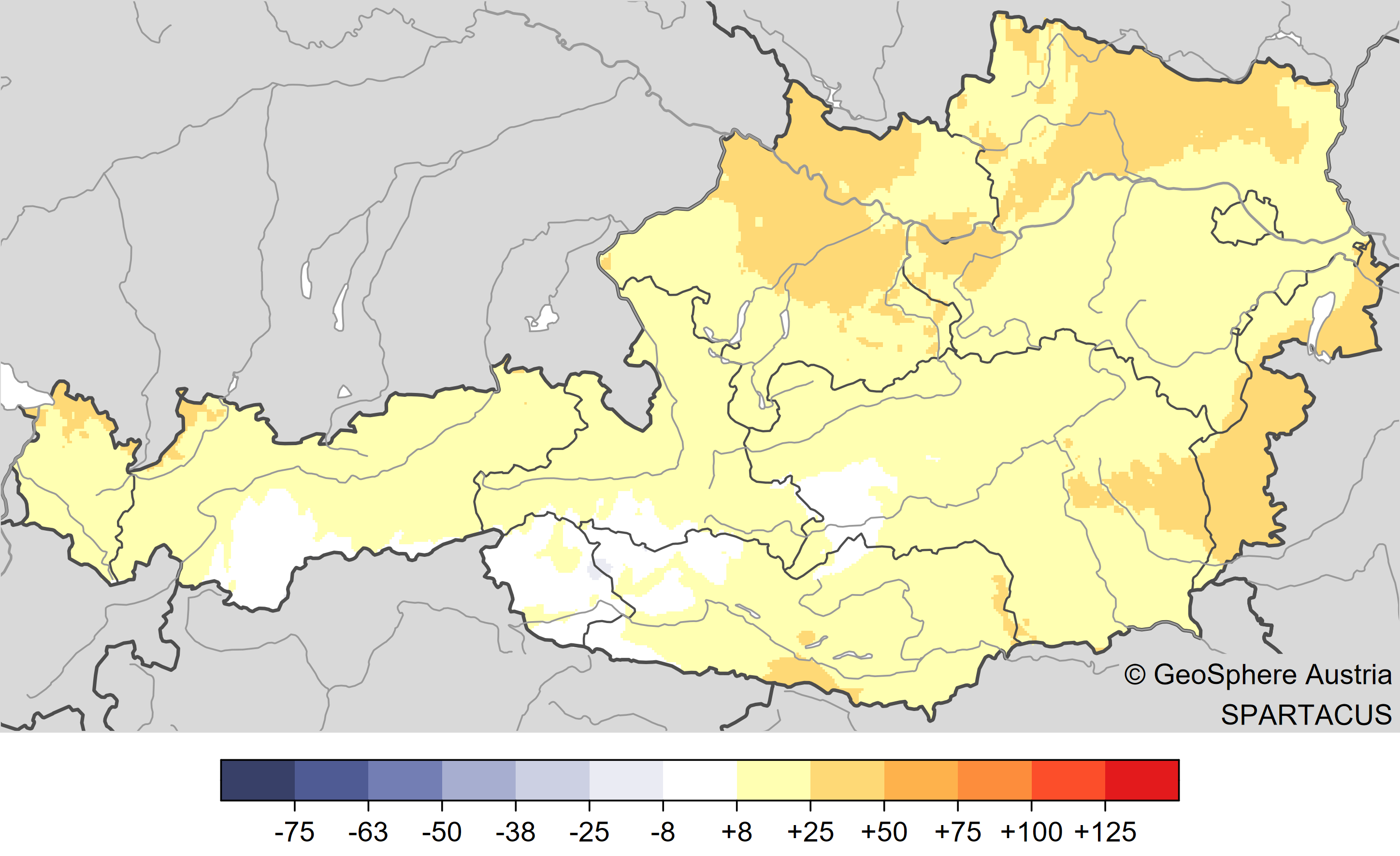
August2026_sun_compare1961-1990.png
Sunshine duration in August 2026 compared with the long-term average from 1961 to 1990. © GeoSphere Austria.
Translated with DeepL.com (free version)