
Earthquakes in October 2026
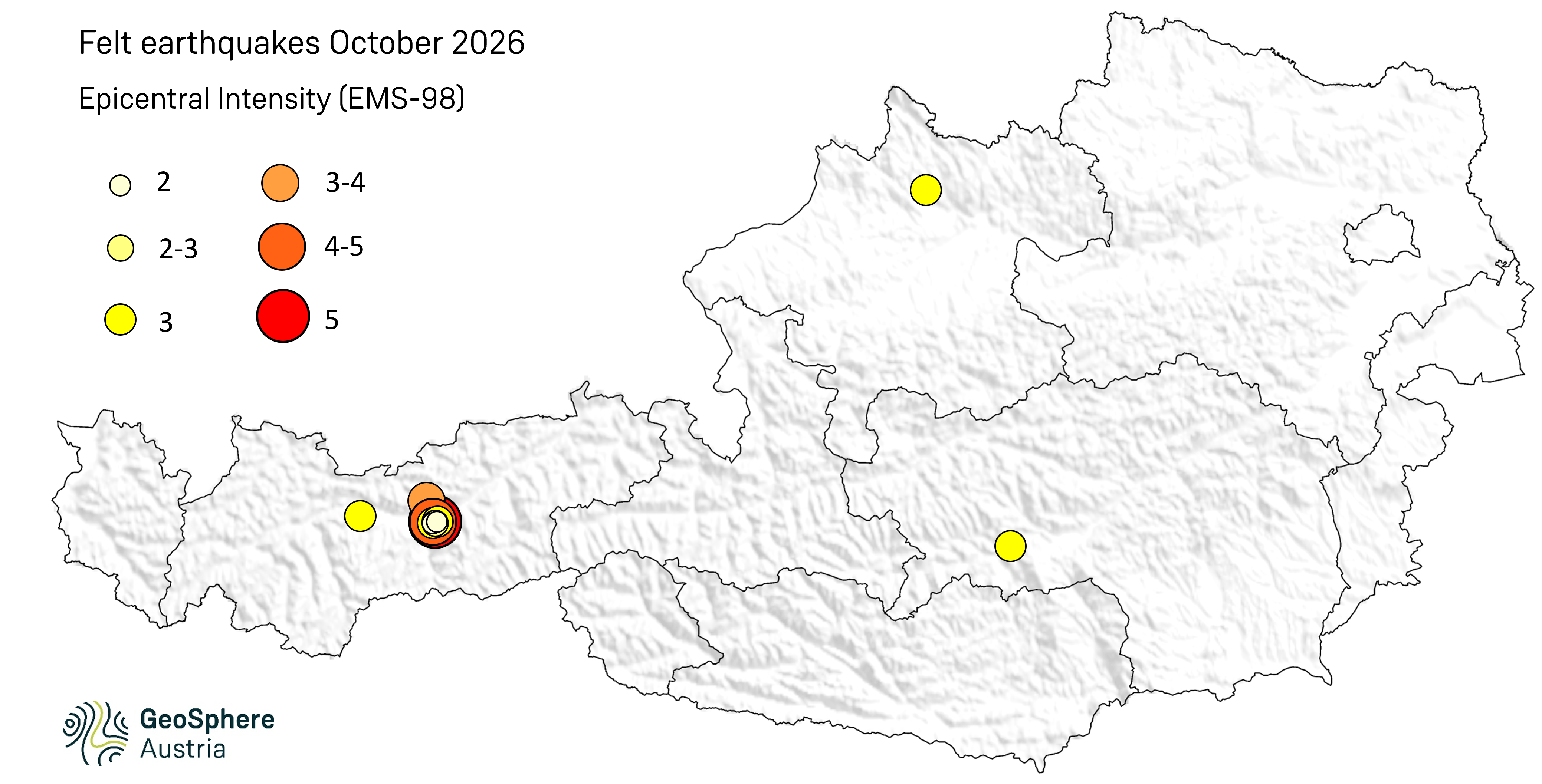
In October, 25 earthquakes were felt by the population in Austria. Of these, 21 occurred in the area southeast of Innsbruck, Tyrol. The other epicenters were also located in Tyrol, Upper Austria, and Styria.
The series of earthquakes with an epicenter near Sistrans, Tyrol (47.23°N, 11.48°E), which had already begun in September, continued into October. Following weak, perceptible events on October 3 and 4, a strong earthquake with a magnitude of 3.6 occurred on October 7 at 3:02 a.m. CEST, which was reported to the Seismological Service by more than 1,500 people. Similar to the event on September 26 (magnitude 3.8), the tremors were strongly felt in the epicentral area and, to some extent, in Innsbruck as well. Buildings were noticeably shaken, residents were startled, and small objects fell over. Some minor damage, such as hairline cracks or small pieces of plaster falling off, and a damaged chimney were reported. The intensity reached a maximum of 5 on the 12-level European Macroseismic Scale (EMS-98). About 8 minutes later, an aftershock of magnitude 1.8 followed, which was felt slightly. Two further weak quakes followed on October 7 at 4:13 a.m. and on October 8 at 2:19 a.m.
On October 9 at 6:46 a.m., many people were once again awakened from their sleep by a strong earthquake in the Sistrans area (47.23°N, 11.47°E). With a magnitude of 3.2, the tremors were once again clearly felt and, in some cases, were frightening. Buildings and furniture shook, and isolated reports of minor damage to buildings were received. The tremors were slightly weaker than those of the previous, stronger events, and the intensity reached 4 to 5 degrees (EMS-98) in the epicentral area. In the hours and days that followed, 14 aftershocks occurred, which were felt by the population with a maximum intensity of 3 degrees. The epicenters of the perceptible earthquakes are summarized in the table below.
On October 4 at 3:31 p.m., an earthquake with a magnitude of 2.1 occurred approximately 6 km northeast of Innsbruck, Tyrol (47.29°N, 11.43°E). It was felt faintly to distinctly and reported to the Seismological Service by more than 70 people. Some people were alarmed, and objects moved slightly. The intensity reached 3 to 4 on the EMS-98 scale.
Also on October 4, the earth shook in Upper Austria. The epicenter of the magnitude 1.4 earthquake, which occurred at 9:34 p.m., was located about 5 km northwest of Aschach an der Donau (48.41°N, 13.99°E). It was felt sporadically as a distinct jolt and a loud bang. The intensity was 3 on the EMS-98 scale.
In Styria, an earthquake with a magnitude of 1.6 was felt on October 12 at 11:10 p.m. It occurred approximately 3 km southwest of Unzmarkt-Frauenburg (47.17°N, 14.43°E) and was noticeable as a faint tremor and rumbling of the ground. The intensity was rated at 3 on the EMS-98 scale.
During the night of October 21–22, at 12:40 a.m., a mild earthquake with a magnitude of 1.8 occurred 8 km south of Telfs, Tyrol (47.23°N, 11.09°E). It was faintly felt in Telfs; glasses and liquids moved slightly. The intensity also was 3 on the EMS-98 scale.
Earthquakes_October_2026.png
Epicenters and intensities of the earthquakes felt in Austria in October 2026. © GeoSphere Austria.
Excerpt from the short form of the 12-level European Macroseismic Scale 1998. based on Mercalli-Sieberg
- Degree 2 – Scarcely: The tremor is felt only by a very few individuals at rest and in an especially receptive position indoors.
- Degree 3 – Weak: The earthquake is felt indoors by a few. People at rest feel a swaying or light trembling. Hanging objects swing slightly.
- Degree 4 – Largely observed: The earthquake is felt indoors by many and felt outdoors only by very few. A few people are awakened. the vibration is moderate. slight trembling of the building or room. Glasses. windows and doors rattle. light furniture shakes visibly.
- Degree 5 – Strongly felt: The earthquake is felt indoors by most. outdoors by few. A few people are frightened and run outdoors. Many sleeping people awake. Observers feel a strong shaking or rocking of the whole building. room or furniture. Small objects may be shifted or fall down. Doors and windows swing open or shut. Hairline cracks appear in a few buildings. particularly those prone to damage.
UTC (Universal Time Coordinated) = GMT (Greenwich Mean Time) Data for worldwide earthquakes according to U.S. Geological Survey M: Magnitude (logarithmic energy scale) Information provided without guarantee
Seismological Service of Austria - GeoSphere Austria Hohe Warte 38, A-1190 Vienna Tel. +43 1 36026 2508 E-Mail: seismo@geosphere.at