
Director General Andreas Schaffhauser elected as new WMO Europe president
Dr. Andreas Schaffhauser, Scientific Director General of GeoSphere Austria, has been elected as the new WMO Europe President. Schaffhauser will serve in this role for the next four years in addition to his responsibilities at GeoSphere Austria. The election of this trained meteorologist underscores Austria’s international commitment and expertise in weather, climate, and natural hazards.
“Congratulations to Andreas Schaffhauser on this election, which also raises international awareness of the outstanding work of the entire GeoSphere Austria team. It demonstrates how highly Austria’s expertise and commitment are valued beyond its borders. International cooperation forms the foundation for further expanding our expertise in the field of meteorology,” said Eva-Maria Holzleitner, Federal Minister for Women, Science, and Research.
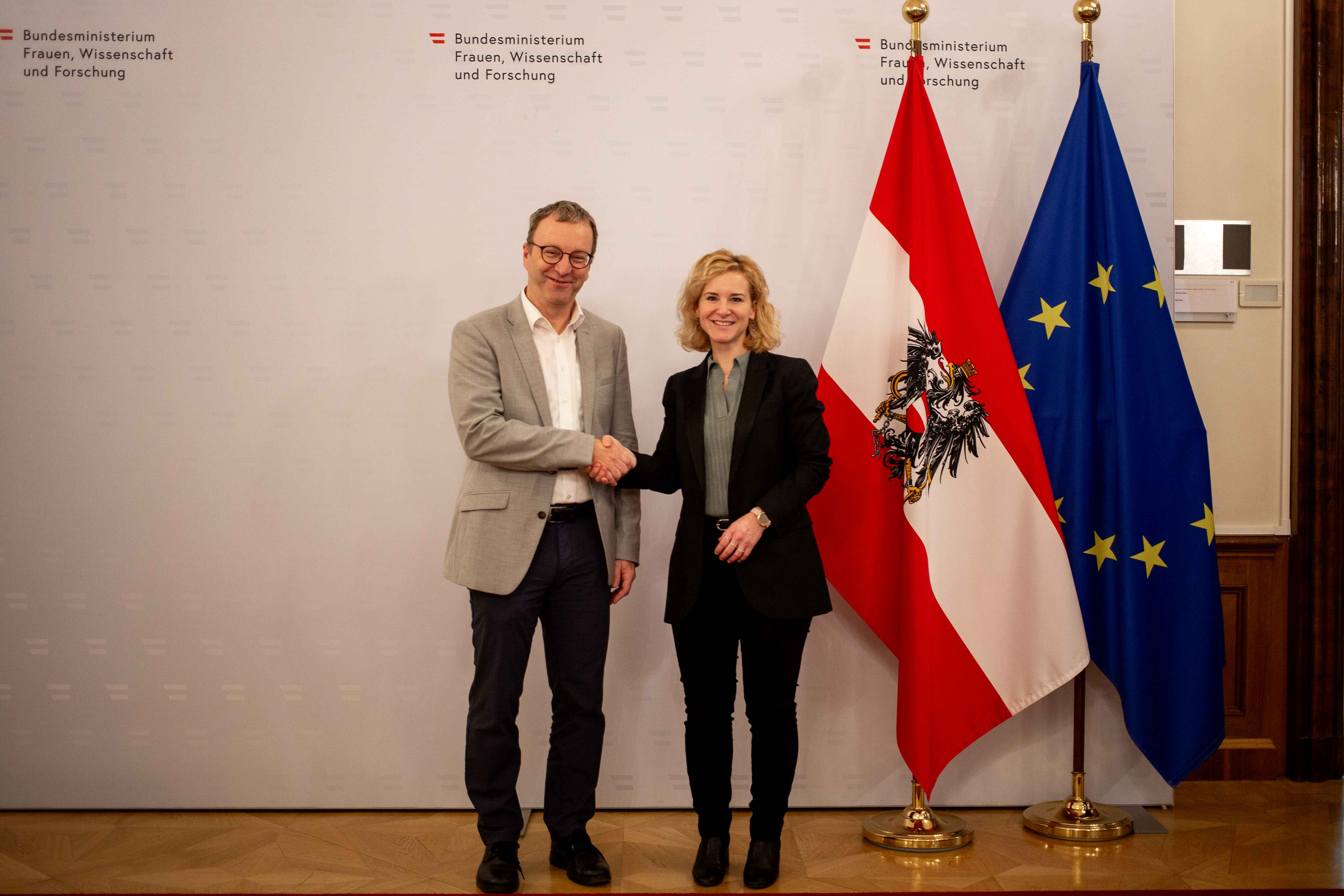
WMO_Schaffhauser_FBMHolzleitner_reduziert.jpg
Eva-Maria Holzleitner, Federal Minister for Women, Science, and Research, congratulates GeoSphere Austria Director General Andreas Schaffhauser on his election as President of WMO Europe. © BMFWF/Keleta.
The WMO is a specialized agency of the United Nations and provides the international framework for cooperation in the fields of weather, climate, water, and related environmental issues. “No country can provide modern weather forecasting and climate monitoring on its own these days. Weather and natural hazards do not stop at national borders; reliable forecasts and warnings rely on the global exchange of observational and satellite data, models, and scientific expertise,” said Andreas Schaffhauser regarding the importance of international cooperation.
His election as WMO President for Europe took place during the 19th session of Regional Association VI in Bucharest. The presidency also entails membership on the WMO’s Executive Council.
Europe is among the regions worldwide that are particularly affected by climate change and increasing extreme events. In addition, new technologies and artificial intelligence, as well as growing financial and institutional challenges, present new challenges for weather, climate, and warning services.
“Austria benefits from this international cooperation every day. At the same time, we can contribute our experience and knowledge and assume responsibility within the international community. This election is therefore also a recognition of the significant international commitment of our scientists at GeoSphere Austria,” emphasizes Andreas Schaffhauser.
Its activities will focus in particular on cooperation among members, the practical exchange of knowledge and experience, and the further development of national meteorological and hydrological services. Regional cooperation is intended to help develop joint solutions and create tangible added value for all members. Regional Association VI extends from the North Atlantic through Europe and the Mediterranean region to Central Asia. In total, it coordinates 50 member states.
GeoSphere Austria is involved in numerous European and international collaborations. These include, among others, participation in the international initiative “Early Warnings for All,” involvement in the Systematic Observations Financing Facility (SOFF), and the operation of MeteoAlarm, the European platform for weather warnings. In addition, the Federal Institute contributes scientific and operational expertise to international programs and supports meteorological services in other countries through peer-to-peer collaborations.
Dr. Andreas Schaffhauser has served as Scientific Director General of GeoSphere Austria since 2023. A native of Styria who grew up in Gratwein, he studied meteorology at the Universities of Graz and Innsbruck and held a Marie Curie Fellowship at the University of Bologna in Italy. After working in the fields of remote sensing and alpine meteorology, he took over as head of the weather, climate, and environmental services at the former ZAMG in 2011, as well as its commercial and international activities. In this role, he steered the organization’s further development toward impact-oriented forecasts and warnings. Over several years, he coordinated and further developed MeteoAlarm—the European impact-oriented warning system. Since 2021, he has served as Austria’s Permanent Representative to the WMO.
Translated with DeepL.com (free version)